
A messy neighbor’s yard, with tall weeds or piles of garbage, impacts your home’s appearance and peace. When your neighbor fails at yard maintenance, it becomes a genuine neighborhood nuisance.
Sending a polite complaint letter to your neighbor about their yard is the simplest way to address this property issue. This article gives you the exact tools to write that letter. We offer clear advice and easy examples to help you achieve yard cleanup resolution without conflict.
Writing a firm, fair letter is crucial. It clearly communicates your concerns about the unkempt property and seeks a respectful solution. Our goal is to make this communication easy, helping you restore a tidy environment and neighborly respect.
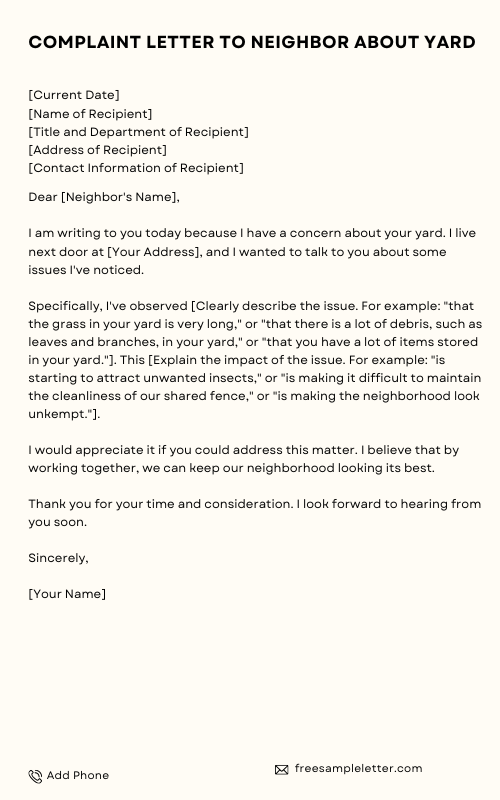
Complaint Letter To Neighbor About Yard
[Your Name]
[Your Address]
[Your Phone Number]
[Your Email Address]
[Date]
[Neighbor’s Name]
[Neighbor’s Address]
Dear [Neighbor’s Name],
I am writing to you today because I have a concern about your yard. I live next door at [Your Address], and I wanted to talk to you about some issues I’ve noticed.
Specifically, I’ve observed [Clearly describe the issue. For example: “that the grass in your yard is very long,” or “that there is a lot of debris, such as leaves and branches, in your yard,” or “that you have a lot of items stored in your yard.”]. This [Explain the impact of the issue. For example: “is starting to attract unwanted insects,” or “is making it difficult to maintain the cleanliness of our shared fence,” or “is making the neighborhood look unkempt.”].
I would appreciate it if you could address this matter. I believe that by working together, we can keep our neighborhood looking its best.
Thank you for your time and consideration. I look forward to hearing from you soon.
Sincerely,
[Your Name]
How to Write Complaint Letter To Neighbor About Yard
Your neighbor’s yard… it can be a source of peace, or a never-ending source of headaches! Let’s face it, sometimes those yards are less “garden of Eden” and more “jungle of despair.” If things have gotten to that point, a polite letter might be your best bet before things get messy. Don’t worry; it doesn’t have to be a nightmare. Here’s how to write a complaint letter that actually works, and doesn’t start a neighborhood feud. We’ll keep things clear and simple.
1. Gather Your Evidence (Detective Mode!)
Before you start scribbling, do some fact-finding. What exactly is the problem? Is it overgrown weeds? Unkempt garbage? A collection of rusty cars? Document everything. Take pictures. Note dates and times. This is your ammo! This evidence will support your claims. You’re not guessing; you know the facts. This detailed information will show you’re serious about the issue. It provides clarity about the nature of the problem. Without facts, your letter might fall flat.
2. Choose Your Tone (Keep it Friendly!)
This is super important. Start with a friendly tone. You’re trying to solve a problem, not declare war. Begin with a warm greeting, something like, “Dear [Neighbor’s Name],” or even “Hi [Neighbor’s Name].” Express your concern in a calm and respectful way.
For example, instead of saying, “Your yard is a disaster,” try, “I’ve noticed some [specific issue] in your yard lately.” Keep it simple, and let the facts do the talking. This polite approach makes them more receptive. It’s easier to have a conversation when you’re not being accusatory. Remember, you’re aiming for a positive outcome.
3. Be Specific and Clear (No Room for Confusion!)
Get straight to the point. Clearly explain the problem. Don’t beat around the bush. State what’s bothering you. Specify the exact issue. Be crystal clear about what you’ve observed. Give dates, times, and any relevant details.
For example, “On July 12th, I noticed a pile of yard waste accumulating near the fence.” The more specific you are, the better. This avoids misunderstandings. It makes it easier for your neighbor to understand and address the problem. It also shows you’ve paid attention. This creates an expectation of mutual respect and attention.
4. Suggest Solutions (Help Them Out!)
It’s always better to suggest solutions. Consider what you would want if you were in their shoes. You could offer helpful suggestions or state your expectations. This displays a proactive approach. Perhaps offer to help (if appropriate) or suggest resources like landscaping services.
This is key! This shows you’re not just complaining but also looking for a fix. If you know the local ordinances, you can mention them, but do it politely. For example, “I’m not sure if you’re aware, but there might be a local ordinance…” This helps them understand and address the situation. Offering a solution also strengthens your point.
5. Keep It Positive and Finish Strong (Aim for a Good Outcome!)
End on a positive note. Express your hope that you can resolve the issue amicably. Thank them for their time and consideration. Include your contact information (phone number or email). A good closing could be, “I hope we can work together to find a solution that works for both of us. I look forward to hearing from you soon.”
Sign the letter with your name. This friendly closure sets a positive tone. It encourages a good relationship. It’s all about achieving a fair outcome. Remember, a little kindness goes a long way when neighbors are involved.
FAQs about Complaint Letter To Neighbor About Yard
What should I include in a complaint letter to my neighbor about their yard?
Your letter needs specific details. Include the date and time of the issue. Describe what you observed. Explain how it affects you. Be clear about what you want them to do. State a deadline for a response.
How do I address my concerns professionally?
Maintain a respectful tone throughout the letter. Avoid accusatory language. Focus on the issue. State the facts. Offer potential solutions calmly. Consider a friendly and collaborative approach.
Can I use a template for my complaint letter?
Yes, templates can be helpful. They provide a structure for your letter. Customize the template with your specific situation. Ensure the information is accurate. Personalize it to fit the situation.
What happens if my neighbor ignores my complaint letter?
If you receive no response, consider your next steps. You might send a follow-up letter. You could also investigate local ordinances. In some cases, you could involve a homeowner’s association. As a last resort, consider legal advice.
What are the best ways to resolve the yard issue?
Communication is key. Try talking to your neighbor in person. This lets you explain your concerns directly. Be open to a compromise. Document all interactions. Consider mediation if necessary. Aim for a mutually agreeable solution.
Related:
Complaint Letter To Neighbor About Dog
Complaint Letter To Neighbor About Trespassing
