
Dealing with neighbor dog problems like excessive barking or pet messes, is stressful. Your home sanctuary is disrupted by ongoing dog-related issues.
A polite, clear complaint letter to your neighbor about their dog is the key to resolution. Effective neighbor communication can restore community peace and mutual respect.
This guide provides practical pointers and letter examples to help you write your neighbor complaint letter. Learn to clearly and respectfully address dog nuisance concerns and achieve a positive dog problem resolution. A well-worded letter is your first step toward better neighbor understanding and a quieter neighborhood.
Complaint Letter To Neighbor About Dog
[Your Name]
[Your Address]
[Your Phone Number]
[Your Email Address]
[Date]
[Neighbor’s Name]
[Neighbor’s Address]
Dear [Neighbor’s Name],
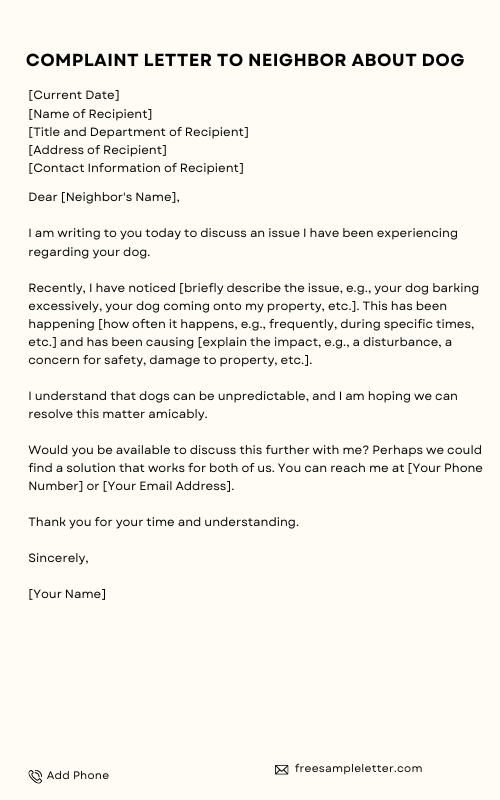
I am writing to you today to discuss an issue I have been experiencing regarding your dog.
Recently, I have noticed [briefly describe the issue, e.g., your dog barking excessively, your dog coming onto my property, etc.]. This has been happening [how often it happens, e.g., frequently, during specific times, etc.] and has been causing [explain the impact, e.g., a disturbance, a concern for safety, damage to property, etc.].
I understand that dogs can be unpredictable, and I am hoping we can resolve this matter amicably.
Would you be available to discuss this further with me? Perhaps we could find a solution that works for both of us. You can reach me at [Your Phone Number] or [Your Email Address].
Thank you for your time and understanding.
Sincerely,
[Your Name]
How to Write Complaint Letter To Neighbor About Dog
Dealing with dog-related issues with your neighbor can be tricky. Let’s face it, nobody wants to be “that” neighbor who’s always complaining. But sometimes, you have to. Writing a complaint letter is a solid first step. It offers a chance to resolve the problem amicably. This guide will help you craft a letter that’s both effective and respectful.
1. Gathering Your Ammo: What to Include
Before you even type a word, gather your facts. What exactly is the problem? Is it excessive barking at all hours? Uncontrolled roaming in your yard? Poop left on your lawn? Note the date, time, and specific details of each incident. This information is crucial. It makes your complaint credible.
Also, think about how the dog’s behavior affects you. Are you losing sleep? Can you enjoy your backyard? Does it pose a safety risk to yourself or your family? Make a list. Keep it objective, focusing on the dog’s actions and how they affect your peace and quiet. Your tone is important; you want to be firm, but friendly.
2. Crafting the Perfect Letter: Structure and Style
Start with a friendly salutation. “Dear [Neighbor’s Name],” is perfect. Next, state your concern clearly and concisely. Start with a brief introduction explaining that you are writing to express your concerns regarding their dog. Then, get straight to the point about the issue, such as excessive barking. Provide the specific details you gathered earlier.
Be specific about the instances. The more details you provide, the better. Be careful; it is essential to stay factual; avoid emotions. After stating the problems, be sure to suggest possible solutions. This shows you’re open to resolving the issue. Consider offering to meet and discuss it with your neighbor. Finish with a polite closing. Something like, “Thank you for your time and consideration,” works well. Sign off with your name and contact information.
3. The Tone Factor: Finding the Right Voice
Your tone can make or break your letter. A friendly and respectful tone is paramount. Remember, you’re trying to solve a problem, not start a war. Avoid accusatory language. Replace phrases like “You always…” with “I’ve noticed…” and “It seems like….”
Keep your emotions in check. If you’re feeling frustrated, take a break before writing. Re-read your letter before sending it. Does it sound fair and reasonable? If it sounds aggressive, rewrite it. The goal is cooperation, not conflict. Be empathetic, and let your neighbor know you understand that dog ownership comes with its challenges.
4. The Backup Plan: What If the Letter Doesn’t Work?
Sometimes, a letter doesn’t solve the problem. If you don’t see improvements, you might need to consider additional actions. Keep copies of all your communications. Consider keeping a detailed log of each incident, including dates, times, and what happened. This information might be needed later.
If the problem persists, consider contacting your local animal control or homeowner’s association. They can offer guidance and support. Also, you might involve a mediator to help facilitate communication and reach a solution. This is all about staying persistent and resolving the issue for everyone’s benefit.
5. Examples and Templates: Get Started Quickly
Here’s a basic template you can adjust:
Dear [Neighbor’s Name],
I’m writing to you today regarding [Dog’s Name]. I’ve noticed [Specific Issue, e.g., frequent barking] during [Timeframe, e.g., the evenings]. For example, on [Date] at [Time], [Specific Details].
This has been impacting [How the issue affects you, e.g., my ability to sleep]. I understand that owning a dog can be challenging, and I wanted to see if we could work together to resolve this. Perhaps [Suggest a solution, e.g., the dog could be brought inside in the evenings].
I’m open to discussing this further. Please feel free to contact me at [Your Phone Number] or [Your Email Address].
Thank you for your time and consideration.
Sincerely,
[Your Name]
Feel free to adapt the template. Personalize it to fit your situation. Good luck!
FAQs About Neighbor Dog Complaint Letter
What is the most effective first step for a dog complaint?
The most effective first step is writing a clear, polite dog complaint letter to your neighbor. This document formally outlines the specific dog behavior issues like excessive barking or pet waste and your desired resolution. It creates a written record of your attempt to resolve the dog nuisance and shows you are seeking an amicable solution before involving outside authorities.
What are the key elements of a formal complaint letter about a dog?
A formal letter must include a clear subject line, your contact information, the date, and a respectful address to your neighbor. Crucially, it must detail the specific dog problem (e.g., “dog barking 7-8 AM daily”), provide specific dates and times as factual evidence of dog nuisance, and suggest a reasonable, constructive dog problem resolution you hope to achieve together.
How do I address a neighbor’s excessive dog barking problem?
Focus on objective facts: clearly state the barking frequency and duration, noting when it occurs (for example, “every night after 10 PM”). Describe the personal impact, such as sleep disruption, and respectfully request they take steps like professional training or consulting a veterinarian to minimize the dog noise. It is important to avoid emotional language to keep the focus strictly on the verifiable issue of excessive barking.
Should I include evidence of the dog’s behavior in the complaint?
Yes, including clear factual evidence of dog nuisance strengthens your letter significantly. For noise complaints, keep a detailed dog barking log with recorded dates and times; for issues like property damage or recurrent pet waste issues, include dated photos or videos. This factual documentation validates your concerns and makes the request for a dog problem resolution much harder for your neighbor to ignore or dispute.
What if the dog is causing property damage or leaving pet waste?
If the dog is causing property damage (like digging or chewing) or recurrent pet messes, clearly document the location and extent of the damage with photographs. State the estimated costs for necessary repair or professional cleanup. Request that the neighbor immediately take steps to control their pet’s actions and offer to discuss potential reimbursement for the proven damages.
Is sending a letter better than speaking to my neighbor directly?
While a direct, friendly conversation can sometimes be effective, a written complaint letter is often the safer and more effective first approach. It prevents misunderstandings, ensures your concerns are clearly articulated without the heat of emotion, and provides essential legal documentation of your attempt at dog problem resolution should the issue escalate to an HOA or animal control.
What should I include in the resolution section of the complaint letter?
The resolution section must state a clear, achievable goal. For barking, request noise reduction by a specific time (such as 9 PM); for pet waste, request immediate and consistent cleanup. Suggest constructive actions like professional dog training or keeping the dog indoors during specific times. This guides your neighbor toward a specific, helpful solution rather than just leaving them with a general complaint.
Are there specific local laws I should mention regarding dog problems?
Research your local dog laws or noise ordinances and briefly mention the relevant statutes (but avoid threatening legal action directly). Knowing the rules regarding dog barking time limits or leash laws demonstrates that you are informed and provides a legal framework for your request. This helps your neighbor understand the necessity of addressing the dog behavior issues within the bounds of local rules.
What should I do if the dog issue persists after sending the complaint letter?
If the issue persists, continue diligently documenting all incidents in your dog barking log or evidence file. Keep copies of all communication you have sent. The next steps involve escalating the issue by contacting your HOA (Homeowners Association) if you have one, your local non-emergency line, or local animal control, using your initial letter and detailed log as key evidence of the ongoing dog nuisance.
Related:
